When we sit down with a client to talk about finishes, the first thing we do is talk about how they actually live. Not what they've seen on Pinterest — how they move through a house, what they touch every day, how the light changes in their rooms from morning to evening. That conversation shapes every material decision we make.
In Southwest Florida, coastal-contemporary is less a trend than a sensibility. It's warm without being beach-kitschy, refined without feeling cold. The materials that carry it well share a few things: natural origin, visible texture, and the ability to age gracefully in a high-humidity, high-light environment.
Here's how we think through the main finish categories.
Why White Oak Floors Work in SWFL Homes
White oak has replaced Brazilian cherry and dark walnut as the hardwood of choice in coastal-contemporary builds — and for good reason. The grain is tight and relatively even, so it doesn't telegraph every scratch or dust particle the way open-grain species do. In wider planks (we typically specify 5" to 7"), the figure becomes quieter, which lets the texture of the wood read without competing with everything else in the room.
In SWFL specifically, we pay attention to how hardwood is kiln-dried and finished. Humidity cycles here are real. We use engineered white oak in most applications — the dimensional stability across seasons is significantly better than solid, and the top layer is thick enough to refinish if ever needed. Wire-brushed or lightly smoked finishes show fingerprints less and bring out the grain in a way that a high-gloss finish never could.
What Limewash and Plaster Do for a Room
Painted drywall is flat. Limewash and venetian plaster are not. That's the entire case for them.
When light moves across a limewashed wall, it picks up variation — subtle shifts in tone and depth that a flat painted wall simply can't produce. In a single-story coastal home with high ceilings and large windows, that movement is constant, and it makes the room feel alive without adding visual complexity.
We tend to use limewash in common areas and primary bedrooms, where the light is most dynamic. Venetian plaster works well in more formal spaces — an entry, a dining room, a primary bath — where you want a more polished surface but still want depth.
Both require skilled application. The material itself is forgiving; the technique is not. We work with the same plasterers on every build because consistency matters. Two different applicators with the same paint will produce two different results.
Natural Stone: Choosing for Longevity and Looks
In SWFL homes, stone is on countertops, floors, shower walls, and often outdoor surfaces. The question we ask clients isn't "what do you love?" first — it's "where is this going and how will it be used?"
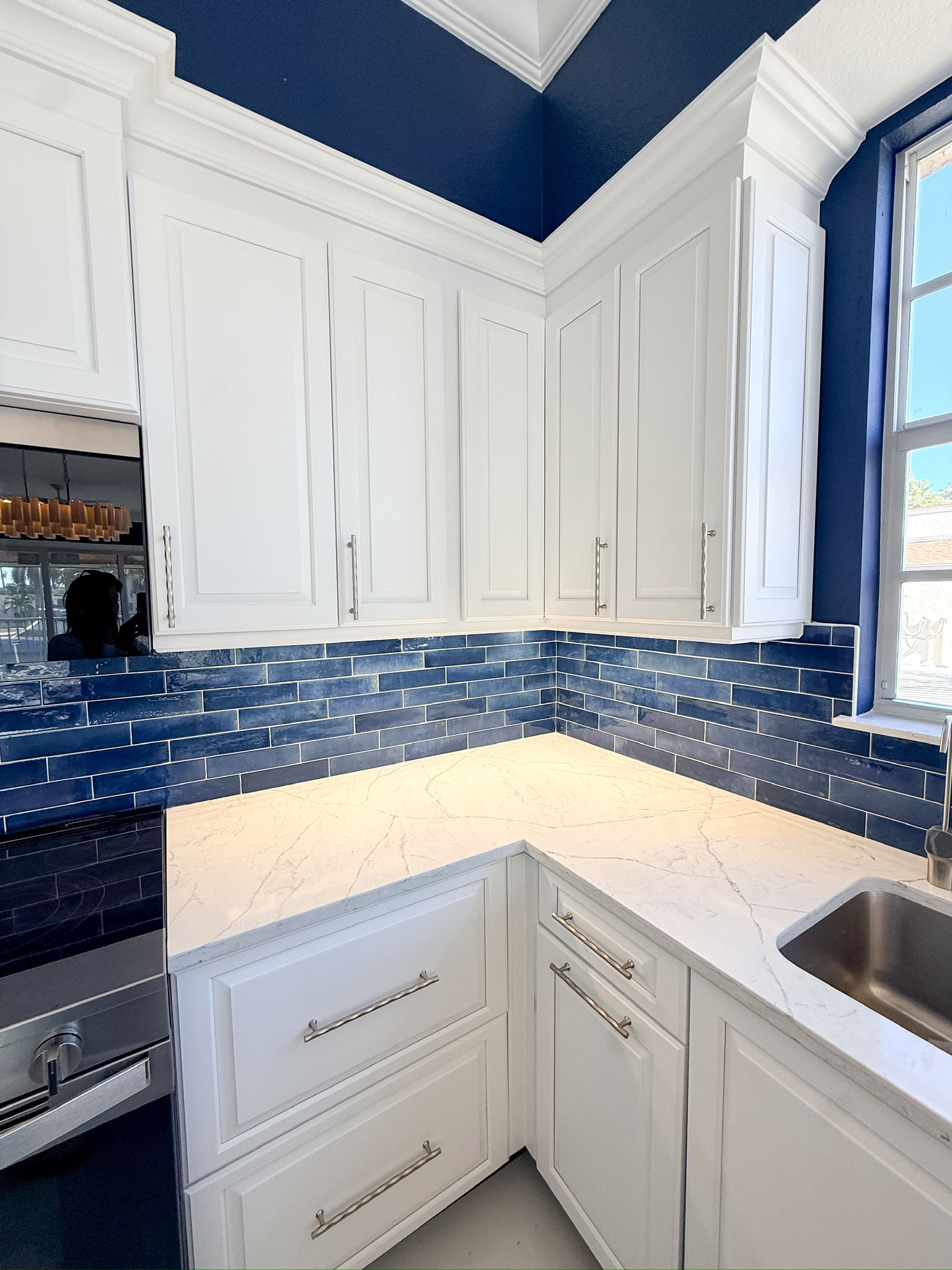
Calacatta and Statuario marbles are beautiful. They're also porous and reactive to acids. In a kitchen that gets used, unsealed marble will etch and stain. That's not a defect — it's the nature of calcium-based stone — but clients should know it going in. For heavy-use kitchens, we often steer toward quartzite, which is significantly harder and more resistant, while still reading as natural stone rather than engineered quartz.
For floors, porosity and slip resistance matter. Travertine has been popular in Florida for decades because it's durable, takes heat well, and has a warmth that porcelain rarely matches. Filled and honed travertine on interior floors — unfilled on outdoor surfaces where the pitting aids traction — is a combination we return to often.
Consistent stone sourcing matters more than most clients expect. We work to specify from the same slab lot for any large continuous surface. Stone from different lots in the same quarry can vary significantly in vein pattern and background color.
How Warm Neutral Palettes Hold a House Together
"Warm neutral" has become a shorthand for beige, and beige deserves its bad reputation only when it's applied without intention. The palettes we find most successful aren't a single color — they're a family of values that move between the floors, walls, and ceiling in a logical progression.
In coastal-contemporary work, that usually means undertones of sand, greige, or warm white — never cool gray, which fights with the warm light and the landscape outside. We layer within that family: a slightly deeper tone on accent walls or cabinetry, a lighter version on ceilings, a natural material like rattan or linen as a textural note.
The goal is a house that reads as consistent room to room without feeling like one color was painted everywhere. Trim color does a lot of this work. White trim on warm-white walls disappears; warm cream trim on warm-white walls creates definition without contrast shock.
Texture Over Ornament
The thing that makes coastal-contemporary interiors feel high-end is the layering of texture. A room can have three or four materials that are all in the same neutral family and still feel rich, as long as they each have a distinct hand and surface quality.
A plaster wall behind a white oak cabinet behind a honed stone countertop next to a linen shade — none of those are competing colors, but together they give the eye something to move through. That's the effect we're building toward. Ornament for its own sake tends to date quickly. Texture doesn't.
Does Material Selection Need to Be Done Early?
It should be. Finish selections affect structural decisions — stone weights, floor thickness, substrate requirements — and pushing them late in the process creates change orders. We begin material conversations during design development, before construction documents are finalized.
Clients who commit to their finish direction early also tend to have less regret. When you can walk a job site and see your floors in the actual light of your actual rooms, you have real information. Making those decisions from a two-inch sample in a showroom is much harder.
Frequently Asked Questions
Are there materials that hold up better in the SWFL humidity and salt air?
Yes. We prefer materials with natural resistance to humidity — engineered hardwood over solid, sealed stone, powder-coated or stainless hardware. For anything near the water or on exterior surfaces, we're especially particular about corrosion resistance and UV stability.
How do you handle material lead times on a custom build?
Long-lead materials — statement stone slabs, custom cabinetry, specialty tile — get specified and ordered during design, not after framing. We build procurement into the schedule from the start so it doesn't compress your completion date.
Can we mix lighter and darker finishes in the same home?
Absolutely. The best interiors usually do. The key is intention — a consistent logic about where the contrast lives and why. We'll lork through that with you during the design phase so the decisions feel cohesive rather than arbitrary.
What's the most common finish mistake in luxury SWFL homes?
Choosing materials in isolation rather than as a system. A countertop that's beautiful on its own can fight with the floor underneath it. We always review selections together, in the context of the full material board, before anything is ordered.
Do you work with our interior designer, or do you have one in-house?
We collaborate with clients' designers frequently. When a client doesn't have a designer, we can recommend people we've worked with well. Either way, the earlier those conversations start, the smoother the process.
Building your home in Naples, Bonita Springs, Marco Island, or Estero? We'd love to talk through what coastal-contemporary means for your specific lot, your light, and the way you live. Contact us here — we're a family-owned team, and we take a limited number of projects each year.
*Premier Magnolia Homes — Licensed FL Certified Building Contractor CBC1267977 | (239) 499-3496 | premiermagnoliahomes.com*